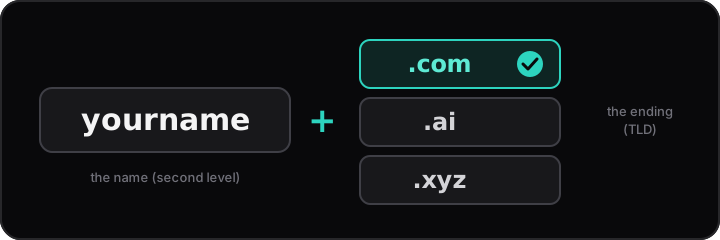
A top-level domain (TLD) is the label at the end of a domain name, after the final dot in example.com. Choose it for its suitability to your audience, its multi-year cost, its registration rules—and whether it works in the ordinary Domain Name System (DNS) wherever you need websites, apps and email to work.
This guide uses current StableDomains catalogue prices checked on 6 November 2026. They are not a forecast for 2027 or a promise that prices will stay fixed. Check the live order quote before paying: standard multi-year registration charges the first-year registration price followed by the current renewal price for each additional year.
StableDomains currently lists 431 paid endings, alongside a .fun test-development ending that is not available to buy. Registration is fulfilled through an ICANN-accredited registrar partner. Free WHOIS privacy is enabled wherever the ending supports it.
A practical answer first
For most global businesses, start by searching for a good .com. Choose .uk or .co.uk when you primarily serve UK customers. For products that benefit from a technology label, .app, .dev, .ai and .io can be useful—but price their renewals before you choose. .xyz can suit experiments and token projects that want a lower first-year commitment, but do not mistake its introductory price for its long-term cost.
The best choice is not simply the ending with the lowest registration price. A fitting, memorable name with a sustainable renewal cost is normally more useful than a long, awkward name in a fashionable ending.
Choose in this order
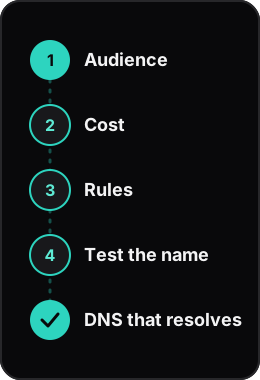
- Identify your audience. Where are your customers? Does a country signal help, or are you building for an international audience?
- Describe the project. Is it a local service, a shop, a developer tool, an organisation or an online experiment? Choose an ending people can understand in that context.
- Check availability and the complete cost. Compare registration, minimum registration period and annual renewal—not merely a promotional first-year price.
- Check eligibility and technical requirements. Some endings have special rules. For example, HTTPS is mandatory on
.appand.dev(see Do I need an SSL certificate?). - Test the name. Say it aloud, type it on a phone and ask someone to repeat it back. Use letters, numbers and hyphens rather than relying on spelling a symbol.
- Choose what resolves for everyone. An ICANN DNS domain works with ordinary websites, browsers, email services and application clients. An alternative blockchain naming system may need special software or a gateway.
Current price comparison
Prices below are for standard, non-premium registrations, checked on 6 November 2026. The three-year figure is one registration year plus two renewals at the displayed standard prices; it is not a future price guarantee.
| Ending | Useful fit | Registration | Annual renewal | Minimum first term | Three-year estimate |
|---|---|---|---|---|---|
.com |
General, global businesses | $16.99 | $20.99 | $16.99 | $58.97 |
.net |
Networks and online services | $20.99 | $25.49 | $20.99 | $71.97 |
.org |
Communities and non-profits | $22.99 | $34.49 | $22.99 | $91.97 |
.xyz |
Flexible brands and web experiments | $4.99 | $30.99 | $4.99 | $66.97 |
.ai |
AI products; 2-year minimum | $169.99 | $169.99 | $339.98 | $509.97 |
.io |
Developer tools and technology brands | $57.99 | $114.99 | $57.99 | $287.97 |
.app |
Apps; HTTPS required | $18.49 | $39.99 | $18.49 | $98.47 |
.dev |
Developer projects; HTTPS required | $18.49 | $45.99 | $18.49 | $110.47 |
.uk |
UK audiences and businesses | $16.79 | $16.79 | $16.79 | $50.37 |
.co.uk |
UK commercial identity | $16.79 | $16.79 | $16.79 | $50.37 |
.si |
Slovenia connections and suitable brands | $33.59 | $33.59 | $33.59 | $100.77 |
Some registry premium names can cost more or have a different renewal rate than this comparison. Always view the exact name’s quote rather than budgeting from its suffix alone.
Search for your name or compare the complete current price list.
gTLD, ccTLD, new gTLD and alternative names
These labels describe technical and policy distinctions, not degrees of professionalism.
- A generic top-level domain (gTLD) is not tied to a particular country. Familiar examples include
.com,.netand.org. - A country-code top-level domain (ccTLD) is delegated to a country or territory.
.ukand.siare obvious geographic examples..ai,.ioand.coare also ccTLDs, even though technology companies often use them for their meaning or appearance. - A new gTLD is a generic ending introduced through an ICANN expansion programme, such as
.appor.dev. Its age does not make it less legitimate. - Alternative naming systems such as Ethereum Name Service or Handshake are not the same as ordinary DNS. A blockchain name may work for a particular wallet or community without resolving globally in browsers, email or API clients.
Look up an ending in the IANA root zone database to see whether the DNS root recognises it. Blockchain extensions and other alternative namespaces must not be promoted as if they were delegated ICANN endings.
Do not confuse .ai branding with geography
.ai is the ccTLD for Anguilla; .io is assigned to the British Indian Ocean Territory. Using either for an AI or technology brand does not bring a general eligibility requirement on StableDomains today, but registry rules and geopolitical arrangements can change. Keep registration details current and review important domains at renewal rather than treating any ending as permanent infrastructure beyond your control.
There is no basis for promising an .io shutdown or a particular migration deadline. ICANN says that the Chagos sovereignty agreement does not automatically retire a country-code ending. Check official IANA and ICANN notices for verified changes.
What suits your project?
| Project | Where to start | Watch-outs |
|---|---|---|
| UK builder, consultant or local service | .uk or .co.uk; check the matching .com if useful |
Register the name people use for the business, not an impossibly long service description |
| International company | .com first; consider a descriptive alternative when the name improves |
Renewal and availability are separate questions; never assume a taken name is for sale |
| AI product | .ai when the budget supports it; .com, .io or .app are workable alternatives |
.ai has a two-year minimum; the product matters more than the label |
| Developer tool | .dev, .io or .com |
HTTPS is mandatory on .dev; consider documentation and email as well as the marketing site |
| Mobile or web application | .app |
HTTPS is mandatory; register the memorable product name, not just a category keyword |
| Community or non-profit | .org where that description is truthful |
A domain alone does not establish charitable status or trust |
| Experiment or token project | .xyz after checking renewal; another fitting general ending if preferred |
Use a normal DNS domain for the website, regardless of which chain the token uses |
| Temporary campaign | A fitting lower-cost ending or a subdomain of the main brand | Campaign domains still renew; do not create more properties than you can maintain |
Launching a token or community experiment? The token and memecoin domain guide explains suitable naming paths without treating .fun as a domain you can buy here.
What about search rankings?
No ending automatically produces better generic Google rankings. Useful, accessible content, satisfied visitors, sound technical implementation and reputable links matter far more than buying a fashionable suffix.
Country-code endings can communicate location to users and search engines. Choose one because you genuinely serve that place, not as an artificial ranking trick. For widely targeted international sites, a generic ending can avoid implying a geographic focus that you do not have.
Keep the advice simple:
- Choose the clearest, most trustworthy name for the people you want to reach.
- Publish genuinely useful content and make the site quick and accessible on mobile devices.
- Use HTTPS, consistent canonical URLs and redirects when moving domains.
- Keep important names registered; changing your web address has a much bigger SEO cost than choosing a conventional ending at the outset.
Names that work for people and agents
An ordinary DNS name remains the practical foundation for websites, OAuth redirects, webhooks, agent cards and support email. StableDomains is built for agents, but the basic requirements are familiar:
- Prefer a short label that is easy to dictate, spell and parse.
- Avoid an ambiguous word joining, accidental double letter or unnecessary punctuation.
- Plan a stable canonical domain for your service rather than changing endpoints whenever a new ending becomes fashionable.
- Publish HTTPS and sensible redirect behaviour; authenticate access to agent purchasing and management functions.
Agents can use the StableDomains MCP server to search and obtain live quotes. Directory-safe connections use https://stabledomains.net/api/mcp/discover; ordering and payment require the full, separately authorised https://stabledomains.net/api/mcp service. Give an agent a spending cap or read-only permissions where appropriate, and have a person approve the final purchase.
You can also inspect the API documentation, set up payment safety rules for agents, and learn how to give an agent a verifiable domain identity.
DNS, privacy and ongoing ownership
A domain registration is not hosting. After purchase, point the domain at your website and configure your email service separately. Preserve existing records when changing DNS, use HTTPS wherever your site is available, and monitor expiry dates.
StableDomains provides DNS and URL-forwarding tools, including a guide to connecting a domain to Vercel. If you delegate DNS to another provider by switching nameservers, recreate all needed records there before abandoning the old DNS configuration.
WHOIS privacy is enabled for every registration where the ending supports it. Where an ending does not support privacy, StableDomains substitutes its business contact details without a street address, as permitted by that service arrangement. If you manage names through an agent, download or retain the relevant registration records and delegate access cautiously.
Will new ICANN endings arrive in 2027?
Some may progress through the 2026 New gTLD Program, but a new ending is not usable until evaluation, contracting and DNS delegation are complete. ICANN lists the official 2026 Round milestones, including Reveal Day on 7 October 2026, String Confirmation Day on 17 November 2026, and a Community Input and Objections Period ending on 16 March 2027.
Do not treat an application as an available registration. Contention, objections, policy reviews and applicant decisions can all affect the schedule. If someone offers a future ending as though it is already working on the public DNS, check the IANA root first.
FAQ
What is the best TLD for a new business?
Usually .com is the default global starting point, while .uk or .co.uk can be clearer for a UK-focused company. Pick the best available name for the audience, then compare renewal prices and eligibility.
Does a .ai or .io domain improve SEO?
No general SEO advantage follows from either suffix. They may match a technology brand, but content, usability, technical quality and reputation are more important.
Are these prices fixed through 2027? No. They were checked on 6 November 2026. Your live order quote is the authoritative price at checkout. Multi-year registration prepays the specified years but does not freeze subsequent renewal prices.
Why is a searched name more expensive than the table price? It may be a premium name. Search and quote results identify premium pricing and the applicable renewal price. Premium orders can be declined before payment if they exceed what StableDomains can currently fund; an inability to place that order does not mean a payment was taken.
Can I pay by card or cryptocurrency? Yes. StableDomains supports card payments through Stripe, with Stripe's processing fee of 2.9% plus $0.30 added at checkout, and USDC or USDT on seven supported networks without a StableDomains payment fee. See ways to pay for a domain.
Can I register for several years?
Usually yes, within the ending's limits. StableDomains' registration API permits up to ten years for standard eligible registrations. .ai currently starts at two years rather than one.
Can anyone buy a .uk or .co.uk here?
StableDomains' current order requirements for both are unrestricted, with free WHOIS privacy included. Registrant and registry policies differ by ending, so check the live eligibility response and order terms when purchasing.
Can I transfer a domain to StableDomains?
Yes. Unlock it at the current registrar, obtain its authorisation code and use POST /api/v1/transfers or the authorised MCP transfer_domain tool. Inbound transfers add one year; confirm the quote before authorising payment, and do not ignore expiry during the process.
Should I buy every spelling and ending of my brand? Only where there is a clear business reason. Defensive registrations can reduce confusion or impersonation risks, but each adds a recurring renewal cost. Prioritise your principal name, common email-confusion variants and markets where protection genuinely matters.
Is a Web3 name a substitute for an ordinary domain? Not when you need universal websites, email or application access. They can coexist, but an alternative naming system's name may require special resolution and should not be described as an ICANN DNS registration.
Choose and check your name
Start with a domain search, review the current pricing, and check the live quote. Developers and agents can use the MCP tools or OpenAPI specification.
Reviewed on 6 November 2026 against StableDomains' live catalogue and cited ICANN/IANA materials. Check prices and programme notices again before making a purchase or a 2027 launch commitment.