People search for "anonymous domain registration" for good reasons: a side project they don't want tied to their employer, a personal site that shouldn't publish a home address, a token launch, or simply avoiding the spam that follows every new registration. This guide explains what is genuinely possible, what isn't, and how to keep a domain purchase as private as the rules allow.
The short version: you can keep your name, email, phone number and address out of the public record, and you can pay without a card or an account. You cannot make a domain legally ownerless or untraceable. Registries, registrars and payment networks all keep records, and they respond to lawful requests. Treat "anonymous" as "private from the public", not "invisible to everyone".
What "anonymous" can and cannot mean
There are three separate things people usually mean:
- Public privacy. Nobody browsing WHOIS or RDAP can see who you are. This is achievable for most endings.
- Payment privacy. The payment isn't linked to a card in your name. This is achievable with stablecoins, with an important caveat about public blockchains (below).
- Total anonymity. No company anywhere can connect the domain to you. This is not realistic, and any service promising it is overstating what it can do.
Keeping those apart makes it much easier to choose sensible steps instead of chasing a promise nobody can keep.
What WHOIS and RDAP publish
Every registered domain has a public record. The older WHOIS protocol and its structured replacement, RDAP, both return it. Some fields are always public because the internet needs them to work:
- the registrar that manages the name,
- creation, update and expiry dates,
- status codes such as
clientTransferProhibited, - the nameservers the domain points to, and
- whether DNSSEC is signed.
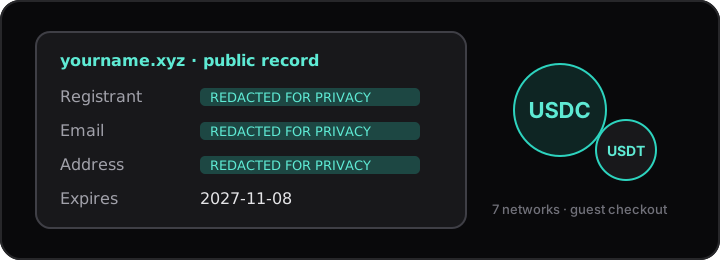
Other fields describe the registrant: name, organisation, email, phone and postal address. Since GDPR, many registries and registrars redact much of this by default. WHOIS privacy goes further by replacing the remaining contact fields with redacted or proxy values, so the record shows something like "REDACTED FOR PRIVACY" instead of your details.
You can see exactly what a domain exposes today with our free WHOIS and RDAP lookup.
How StableDomains handles privacy
These are the parts we control, stated plainly:
- No registrant contact fields from you. When you buy through StableDomains you don't type a name, phone number or postal address into the order. StableDomains registers with its own registrant contact, through an ICANN-accredited registrar partner. You manage the domain through your order, wallet sign-in or email recovery.
- WHOIS privacy on by default, free. Privacy is applied automatically wherever the registry allows it, so registrant details are redacted in public WHOIS and RDAP. There is no add-on to remember and no yearly privacy fee.
- Guest checkout. There is no account to create. You can add an email so we can send a receipt and you can recover the order later; you can also sign in with an Ethereum wallet (Sign-In with Ethereum) instead of an email and password.
- Crypto payment. Pay in USDC or USDT on Base, Ethereum, Arbitrum, Polygon, HyperEVM, BNB Chain or Solana. The domain is registered as soon as the payment confirms. Card payment through Stripe is also available if you prefer it, with Stripe's fee added at checkout.
- Agents can buy too. Software can register over the API, the MCP server or x402 pay-per-request, without a stored card. See how AI agents register domains.
Some endings have their own rules. A few registries don't allow privacy services, and some require local presence or an eligibility ID (for example .us, .ca, .eu and .au). StableDomains refuses orders for endings with eligibility rules it can't meet before you pay, rather than failing after payment.
The limits you should know about
Blockchains are public. A USDC or USDT payment is visible on its chain to anyone who knows the transaction. It doesn't contain your name, but if the paying wallet is linked to you elsewhere, such as an exchange account with identity checks or an ENS name, the payment can be linked to you too. Use a wallet you are comfortable having associated with the purchase.
Cards identify you. A card payment goes through Stripe and your card issuer, so it is tied to you by design. That's fine if you only want public privacy; choose stablecoins if you also want payment privacy.
Records exist and lawful requests are answered. Registrars and registries must respond to valid legal process and to abuse reports. Privacy protects you from scraping, spam and casual lookups. It does not shield illegal activity, and registrations used for abuse can be suspended.
Your website can give you away. Hosting account details, analytics IDs reused across sites, an email signature or the same Google account on several projects can all reveal more than WHOIS ever would. Check what your site and DNS records publish, not just the registration.
Email on your domain. MX and SPF records are public. If your mailbox provider's records or a DKIM selector identify an account in your name, that link is visible. Our DNS and email checker shows what anyone can read.
Step by step: buying a domain privately
- Search the name. Use the domain search. Check the first-year price and the renewal price, because renewal is what you pay every year after.
- Pick an ending that allows privacy. Most generic endings such as
.com,.net,.org,.xyz,.appand.devwork well. If you need a country ending, check its rules first. - Decide what to share. Leave the email out if you don't want a receipt, or use an address reserved for registrations. If you lose access, an email is the easiest way to recover your orders.
- Pay in stablecoins. Choose USDC or USDT and the network you already use. Send from a wallet you are happy to have associated with the purchase. See paying with crypto.
- Check the public record. Once registered, run the domain through the WHOIS lookup and confirm that contact fields are redacted.
- Set DNS deliberately. Point the domain at hosting you are comfortable being associated with. Free URL forwarding and hosted DNS are included.
- Renew on time. An expired domain can be re-registered by anyone. Note the expiry date and renew early.
Private registration vs other options
| Approach | Public record | Payment link to you | Practical? |
|---|---|---|---|
| Ordinary registration with your details | Shows whatever isn't redacted by default | Card in your name | Easy, least private |
| Registrar with paid privacy add-on | Redacted while the add-on is active | Usually a card | Works, extra yearly cost |
| StableDomains: privacy on by default, stablecoin payment | Redacted where the registry allows | A wallet address, not a card | Easy, no extra fee |
| Blockchain-only names (ENS and similar) | Ownership is the public wallet | Public on-chain | Needs special software; not an ordinary DNS domain |
Blockchain naming systems are a different product. They don't resolve in ordinary browsers and email without a gateway, and ownership is visible on-chain. For a normal website or email address, a DNS domain with privacy is the more private and more practical choice.
FAQ
Is anonymous domain registration legal? Yes, keeping your details out of the public record is legal and common. Using a domain for fraud, abuse or other illegal activity is not, and privacy doesn't change that. Registrars respond to lawful requests and abuse reports.
Can I buy a domain without giving my name and address? At StableDomains, yes. You don't enter registrant contact fields; we register with our own registrant contact and apply free WHOIS privacy where the registry allows it.
Is WHOIS privacy free at StableDomains? Yes. It is on by default for every ending that supports it, at no extra cost.
Can I buy a domain with crypto anonymously? You can pay with USDC or USDT on seven networks with no account and no card. The payment is public on its blockchain, so it's only as private as the wallet you send from.
Do I need an account or an email? No account is needed. An email is optional; it gets you a receipt and lets you recover orders. You can also sign in with an Ethereum wallet.
What stays public even with privacy? The registrar, the registration and expiry dates, status codes and nameservers. These are needed for the domain to work and for transfers.
Which domain endings don't support privacy? Some country-code registries restrict privacy services or require local presence or an ID. StableDomains blocks endings with eligibility rules it can't meet before you pay, and the live quote shows what applies.
Can someone find out who owns my domain anyway? Registries, registrars and payment providers can link records when legally required. Your own website, hosting, analytics and email setup can also reveal you. Privacy removes the easy public route, not every route.
Can an AI agent buy a private domain for me? Yes. Agents can search, quote and register over the API, MCP or x402 and pay in stablecoins; the same default WHOIS privacy applies.
Find a private domain now
Start with a domain search, compare current prices, and pay in USDC or USDT. If you're still choosing an ending, read how to choose a domain ending (TLD) in 2027.
Reviewed on 7 November 2026 against StableDomains' live checkout, order rules and public WHOIS/RDAP behaviour.